Purchase Orders and Instant Purchases
Procurement is the process of acquiring goods, materials, and services from external sources to support an organization’s daily operations. Every organization, whether a hospital, a school, a factory, or a restaurant, must purchase items to function. These purchases range from small, everyday supplies like office stationery to large, expensive equipment or bulk raw materials for production.
Managing these purchases requires structure and discipline. If every employee bought whatever they wanted whenever they wanted, the organization would lose control of its budget, run out of critical supplies, and lack any record of where money was spent. To prevent this, organizations rely on formal procurement processes. Within this structure, two distinct methods are primarily used to acquire goods: Purchase Orders and Instant Purchases.
While both methods result in receiving goods, they serve entirely different purposes, follow different rules, and are used in completely different situations. Understanding the difference between the two is the foundation of effective procurement management.
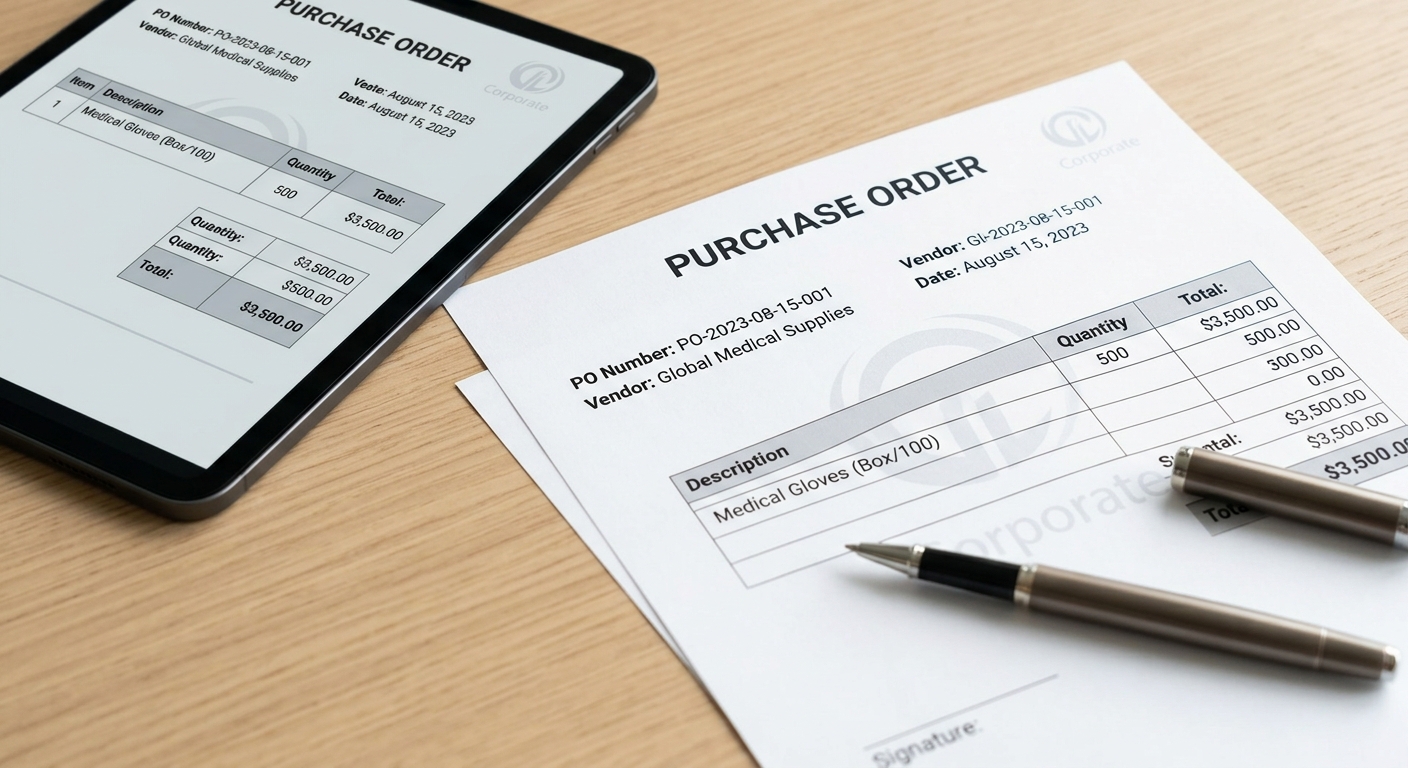
Core components of formal procurement
Regardless of the method used, every procurement transaction involves core components that must be addressed to ensure the purchase is valid, tracked, and settled.
Component | Description |
|---|---|
Requestor | The individual or department initiating the purchase |
Vendor/Supplier | The external entity providing the goods or services |
Items/Services | The specific products or labor being purchased |
Price | The agreed cost per unit or flat fee |
Approval | The authorization required to commit funds |
Payment | The financial settlement of the transaction |
Record Keeping | The documentation and audit trail of the entire event |
Method 1: The Purchase Order (Planned Procurement)
A Purchase Order is a formal, legally binding document issued by a buyer to a supplier. It is an official request to purchase specific goods at a specific price, to be delivered by a specific date. It is not a request for a price quote; it is a commitment to buy. When a supplier accepts a Purchase Order, they are legally obligated to deliver the goods at the agreed price.
Core components of a Purchase Order
A Purchase Order is built around several distinct components that work in sequence. Each component depends on the previous one being completed before the next can begin.
Component | Answers the question |
|---|---|
Vendor | Who is the supplier? |
Items & Services | What is being bought? |
Approval | Is the purchase authorized? |
Purchase Order | What is the binding contract? |
Receiving & GRN | What physically arrived? |
Inspection | Is the quality acceptable? |
Bill Creation | What is the financial liability? |
Bill Payment | Was the debt settled? |
Vendor
The Vendor is the external supplier who provides the goods or services. Every Purchase Order must be linked to a specific vendor. This ensures that the organization knows who is responsible for delivering the goods and who must be paid. Vendors can be large manufacturers, local distributors, or service providers.
Typical vendor types include:
Manufacturers
Wholesale distributors
Local retailers
Service providers
Items and Services
Items are the physical goods being purchased. They are the core reason the Purchase Order exists. Each item must be clearly identified with a product name, quantity, and unit of measurement. Units of measurement include pieces, boxes, kilograms, liters, or any other applicable standard.
Services are non-physical purchases. A Purchase Order can also be used to buy services such as equipment maintenance, consulting, software subscriptions, or cleaning contracts. Services do not add to physical inventory stock, but they still represent a financial commitment that must be approved and paid for.
Approval
Approval is the process of verifying that a Purchase Order is valid and authorized. Before a Purchase Order is sent to a vendor, it must be reviewed by designated personnel. Approvals ensure that the purchase is justified, within budget, and aligned with organizational policy.
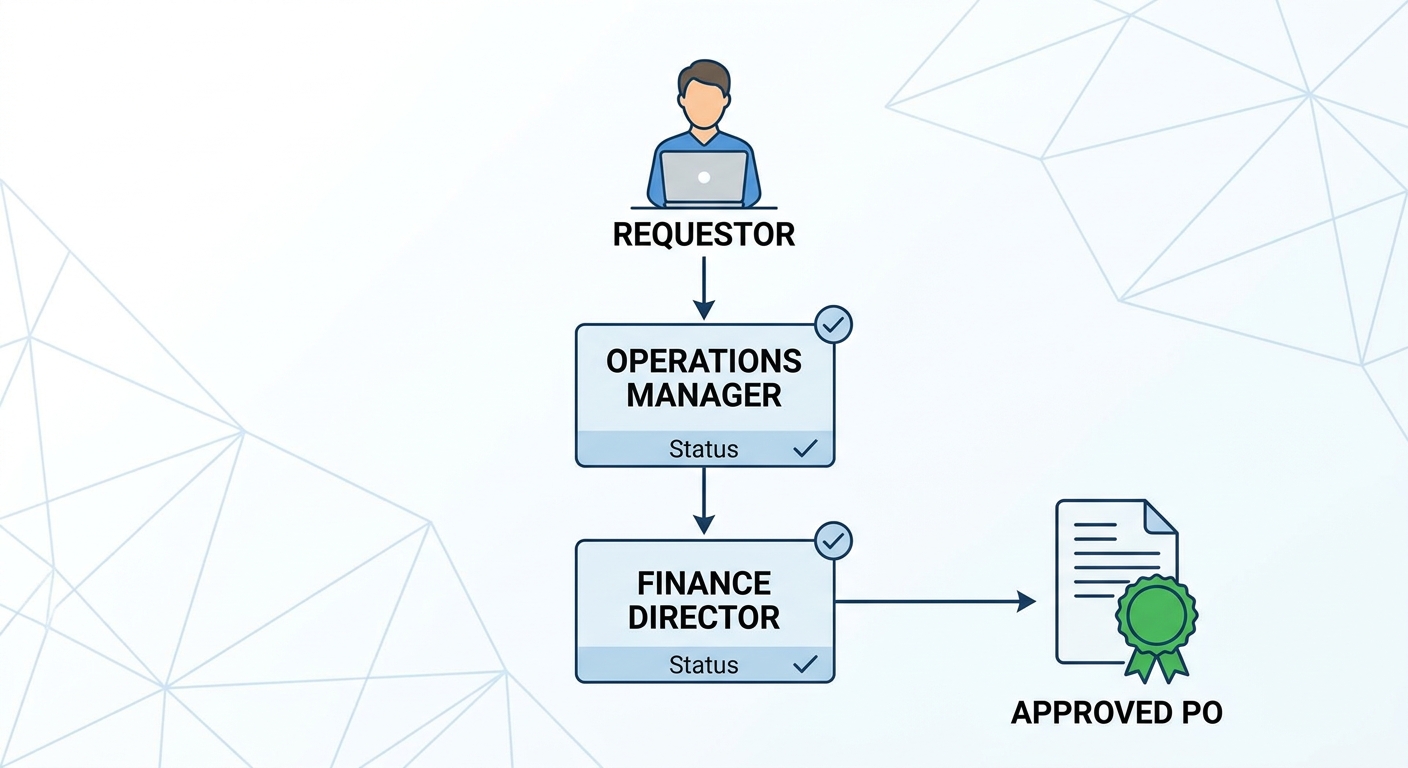
Single-level approval
When only one approval level exists, every transaction requiring approval is routed directly to it.
The transaction becomes fully approved immediately after approval is granted at that single level.
Multi-level approval
Organizations often require sign-off from multiple departments before a transaction can proceed. In this case, several approval levels are chained together.
How a multi-level approval progresses
Each approval level must complete its review before the request moves to the next level.
If approval is rejected at any level, the workflow stops immediately and the transaction is not processed further, unless corrective action is taken.
Once every level has approved, the transaction becomes fully authorized.
This sequential approach ensures each department reviews only the transactions relevant to its responsibility, while maintaining accountability throughout the process.
Purchase Order
The Purchase Order is the central document of the entire transaction. It is the formal, legally binding record that defines what is being bought, the price, the delivery date, and the vendor. The Purchase Order is created after approval is complete. It serves as the master reference for all subsequent steps.
A Purchase Order typically contains the following information:
Field | Description |
|---|---|
PO Number | Unique reference number for identification |
Vendor | The supplier providing the goods |
Issue Date | The date the order was created |
Due Date | The expected delivery date |
Items | List of goods being purchased |
Quantities | Number of units for each item |
Unit Price | Cost per unit |
Grand Total | Total value of the order |
Approval Status | Current state of authorization |
Receiving
Receiving is the physical action of checking the delivered goods against the Purchase Order. The receiving clerk opens the boxes, counts the items, and verifies that the quantities and product names match the Purchase Order. If there are discrepancies, such as damaged items or short quantities, these are recorded during the receiving step.
Action | Purpose |
|---|---|
Count quantities | Verify that the delivered amount matches the order |
Check product names | Ensure the correct items were delivered |
Record batch numbers | Enable traceability for recalls |
Record expiry dates | Prevent use of expired stock |
Identify damage | Note damaged items for return |
Goods Receive Note (GRN)
The Goods Receive Note is a document generated at the moment the physical goods arrive at the warehouse. It confirms that the shipment has been received and details the quantities, batch numbers, and expiry dates of the items. The GRN acts as proof of delivery and is used to verify that the supplier fulfilled the order.
A GRN typically contains the following information:
Field | Description |
|---|---|
GRN Number | Unique reference number |
Purchase Order Reference | Links the GRN to the original order |
Supplier | The vendor who delivered the goods |
Date Received | The date the goods arrived |
Items Received | List of items and quantities |
Batch Numbers | Supplier lot numbers for traceability |
Expiry Dates | Expiration dates for shelf-life tracking |
Condition Notes | Any damage or discrepancies |
Inspection
Inspection is the quality control step that occurs after receiving. The inspector checks the delivered items for damage, defects, expiration dates, or quality issues. Only items that pass inspection are added to usable inventory.
The inspection process includes:
Visual inspection for physical damage
Verification that quantities match the order
Checking expiration dates
Testing for quality compliance
Identifying and separating defective items
Store
The Store is the specific physical or logical location where the received goods are placed. This could be a main warehouse, a pharmacy, a laboratory store, or a supply closet. The store determines which inventory count is increased when the goods are received.
Typical store types include:
Main Warehouse
Pharmacy Store
Laboratory Store
Supply Closet
Production Floor
Bill Creation
The Bill is the formal recording of the supplier's invoice. After the goods are received and inspected, the supplier sends a legal invoice requesting payment. This invoice is recorded as a Bill and matched against the Purchase Order to ensure the amounts align.
A Bill typically contains the following information:
Field | Description |
|---|---|
Bill Number | Supplier's official invoice number |
Bill Date | Date the invoice was issued |
Purchase Order Reference | Links the bill to the original order |
Supplier | The vendor requesting payment |
Total Amount | The total amount due |
Due Date | The date payment must be made |
Installments | If split payments are allowed |
Bill Payment
Bill Payment is the final financial action. The finance department transfers funds to the vendor to settle the outstanding debt recorded in the Bill. Recording the payment closes the financial loop, clears the liability, and marks the Purchase Order as fully settled.
Action | Purpose |
|---|---|
Enter amount paid | Record the exact amount transferred |
Attach payment proof | Attach bank receipt or cheque copy |
Save payment | Finalize the settlement |
Clear balance | Reduce due amount to zero |
The Purchase Order Lifecycle
A Purchase Order goes through a distinct lifecycle. It is not a single event; it is a sequence of actions that must occur in order. The lifecycle moves from the initial request for goods through to the final settlement of the supplier's invoice.
How a Purchase Order progresses to completion
Purchase Requisition: An internal request for goods is created by an employee.
Approval: The request is reviewed and authorized by management.
Purchase Order: The approved request becomes a formal binding contract sent to the supplier.
Receiving & GRN: The goods arrive and are verified against the order. A Goods Receive Note is generated.
Inspection: The items are checked for damage or quality defects.
Billing: The supplier sends an invoice, which is matched to the Purchase Order.
Payment: The invoice is approved and funds are transferred to the supplier.
Method 2: Instant Purchases (Unplanned & Urgent Procurement)
An Instant Purchase, sometimes referred to as a Petty Cash Purchase or a Direct Purchase, is a procurement transaction that occurs outside of the formal Purchase Order workflow. It is a quick, unplanned purchase made to satisfy an immediate need. Unlike a Purchase Order, which requires pre-approval and a formal contract, an Instant Purchase is recorded at the moment the transaction occurs.
Core components of an Instant Purchase
An Instant Purchase is streamlined and contains fewer components than a Purchase Order. Because it bypasses the formal approval and receiving processes, it relies on immediate reconciliation.
Component | Answers the question |
|---|---|
Requestor | Who needed the item? |
Supplier | Where was it bought? |
Item | What was bought? |
Receipt | What is the proof of purchase? |
Expense Record | How was the transaction recorded? |
When to use an Instant Purchase
Instant Purchases are designed for urgent, low-value, or unexpected needs. They are used when the organization does not have time to go through the lengthy approval process of a Purchase Order. Typical situations that require an Instant Purchase include running out of printer ink and needing a replacement immediately to continue working, a maintenance technician discovering a broken pipe and needing to purchase a replacement valve from a local hardware store right away, an employee buying lunch for a group of visiting clients and needing to be reimbursed, or purchasing small incidental items where the cost of processing a formal Purchase Order exceeds the cost of the item itself.
The Instant Purchase process
The Instant Purchase process is much shorter than the Purchase Order process. It generally begins when an employee identifies an immediate need for a low-cost item. The employee travels to a local vendor or retail store and purchases the item directly. The employee obtains a physical receipt as proof of the transaction. Finally, the employee submits the receipt to the finance department to record the expense. The transaction is complete.
Key Differences Between Purchase Orders and Instant Purchases
The two methods of procurement serve different purposes. Knowing which one to use is essential for maintaining both operational efficiency and financial control.
Factor | Purchase Order | Instant Purchase |
|---|---|---|
Timing | Planned in advance | Urgent and immediate |
Approval Required | Yes. Requires requisition and multi-level approval | No. Bypasses formal approval |
Value | Usually high-value or bulk orders | Usually low-value or incidental |
Supplier | Pre-selected, contracted, or negotiated vendors | Local vendors, casual suppliers, or retail stores |
Contract | Legally binding contract | No formal contract; transaction is immediate |
Payment Timing | Payment occurs weeks later, after invoice is received and matched | Payment occurs immediately at the point of sale |
Record Keeping | Creates a multi-step audit trail (Requisition → PO → Receipt → Invoice → Payment) | Relies on a single physical receipt |
The Internal Flow of Procurement Money
To fully understand the difference between these two methods, it helps to understand how money moves within an organization.
When a Purchase Order is created and approved, the organization is making a financial commitment. The money is not leaving the bank account yet, but it is reserved. The organization knows that payment will be due in the future. When the goods arrive and the invoice is received, the organization must pay the supplier within the agreed terms, which is often 30 or 60 days after delivery.
When an Instant Purchase is made, the financial transaction is immediate. The money leaves the bank account at the same moment the goods are acquired. There is no future liability to track because the transaction is settled at the point of sale. The only remaining task is recording the expense for accounting purposes.
Why Organizations Use Both Methods
A common misconception is that one method is inherently superior to the other. In reality, a well-run organization uses both methods to balance control and agility.
If an organization used only Purchase Orders, it would have excellent financial control but terrible agility. Employees would be forced to go through a lengthy approval process to buy a single box of pens, wasting time and frustrating staff. If an organization used only Instant Purchases, it would be highly agile but lack financial control. There would be no budget oversight, no way to track large expenditures, and no legal protection from suppliers.
By using Purchase Orders for large, planned purchases and Instant Purchases for small, urgent needs, the organization achieves both security and speed.
Summary Table: When to Use Each Method
Situation | Recommended Method | Reason |
|---|---|---|
Buying 500 boxes of medical gloves | Purchase Order | High value, planned, requires approval |
Buying a new ultrasound machine | Purchase Order | Capital expense, requires tracking and depreciation |
Running out of printer paper during a meeting | Instant Purchase | Urgent, low value, immediate need |
Reimbursing an employee for taxi fare | Instant Purchase | Incidental expense, no supplier contract needed |
Restocking a bulk warehouse | Purchase Order | Large quantity, pre-negotiated supplier pricing |
Buying a power strip for a new desk | Instant Purchase | Low value, one-time purchase, immediate requirement |
How to decide which method to use
Is the purchase urgent, low-value, or incidental?
If yes, use an Instant Purchase. If no, proceed to the next step.
Is the purchase large-scale, high-value, or for a contracted supplier?
If yes, use a Purchase Order.
If the purchase is planned but medium-scale, check the organization's threshold policy to determine the required method.
This dual-method approach provides flexibility, accountability, and operational efficiency—enabling organizations to handle routine, planned purchases with control while addressing urgent, incidental needs with speed.